You have no items in your shopping cart.
- New UserRegister now and make the most of My Account.
- Register
Search
Article By: Team Meraki
With ongoing global unrest, the pressures on the fashion industry are becoming increasingly apparent. Few areas reflect this strain more clearly than the widening divide between labour-intensive craftsmanship and the accelerated pace of fast fashion. While the latter continues to reshape consumer behaviour through accessibility and affordability, it does so at a cost that is becoming increasingly difficult to ignore.
Fast fashion has fundamentally altered the landscape of consumption. Driven by rapid production cycles and amplified by digital platforms such as Instagram, TikTok and Facebook, it thrives on immediacy. Trends are produced, circulated and replaced within weeks, creating a system built on speed and volume. However, this model is heavily reliant on low-wage labour, often concentrated in developing economies such as Bangladesh, Vietnam, India and Pakistan, where regulatory frameworks remain fragile.
Factories across these regions (Bangladesh, India, China, and Pakistan with manufacturing centres in Vietnam, China, and India) face relentless pressure to deliver high volumes within compressed timelines - sometimes as short as 10 to 12 days. This urgency often translates into meagre wages, limited worker protections and, in some cases, exploitative labour practices. Subcontracting further complicates oversight, with production frequently outsourced to smaller, unregulated units where ethical standards are harder to enforce. The result is a system where cost efficiency is prioritised, often at the expense of both quality and human welfare.
What remains largely invisible within this system is the human pace of production - one that cannot be accelerated without consequence.
The scale of this dependency is significant. Bangladesh, for instance, derives a substantial portion of its export revenue from textiles and garments, while India’s garment sector continues to expand as a global manufacturing hub. Yet behind this growth lie ongoing concerns surrounding labour conditions, including the persistence of child labour and informal employment structures. Despite national and international efforts to address these issues, enforcement remains inconsistent.
Bangladesh, India, China and Pakistan are major suppliers for fast fashion brands such as Zara, Inditex, H&M and SHEIN. Driven largely by profit and scale, quality and ethical practices are often sidelined. Brands frequently subcontract production to smaller factories based on competitive pricing and tight delivery timelines. Often located in rural areas, these subcontractors may employ underage workers and low-paid labour in order to minimise production costs.
Bangladesh is regarded as a key hub of the global fashion industry, with approximately 80 percent of its export earnings derived from textiles and garments. In 2022, a survey reported that the number of child labourers stood at 4.7 million. Meanwhile, India’s garment sector, valued at USD 100 billion, was estimated in a 2020 report by the Global March Against Child Labour to involve more than 12 million children.
India continues to face significant challenges, with the Global Slavery Index estimating that more than 8 million people are forced into manual labour on extremely low wages. These staggering figures remain a cause for concern, despite the existence of national programmes aimed at addressing child labour.
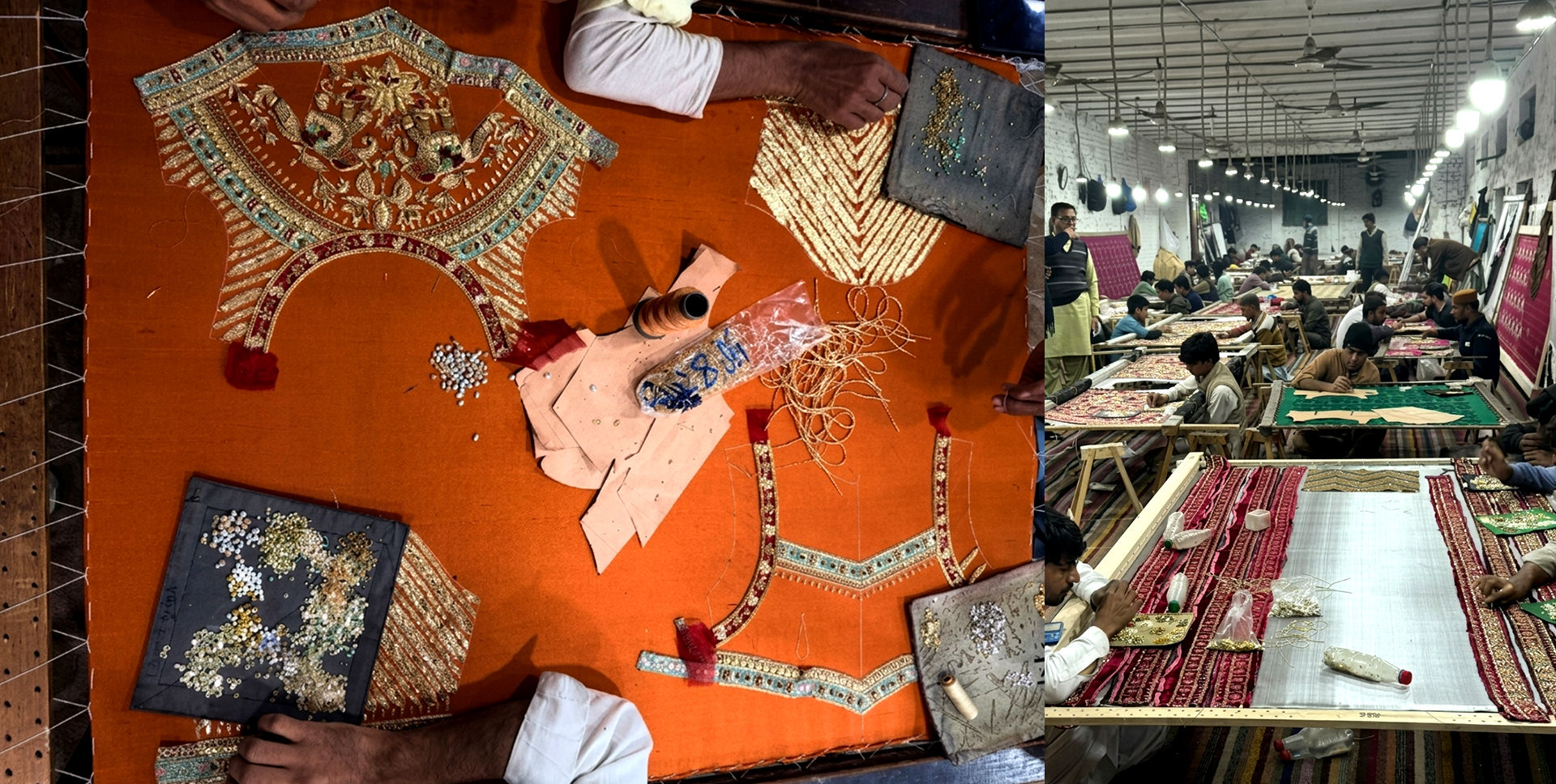
At the other end of the spectrum lies bridal couture - an industry defined not by speed, but by time. In South Asia and the Middle East, bridal wear represents far more than fashion; it is a cultural artefact shaped by heritage, artistry and generational skill. Each garment is the result of painstaking craftsmanship, often requiring weeks or even months of labour. Skilled karigaars dedicate countless hours to intricate embroidery, embellishment and hand-finishing - processes that cannot be replicated at scale.
A single bridal ensemble may pass through dozens of hands, each artisan contributing a specialised skill refined over years - if not generations - of practice.
This contrast reveals the paradox at the heart of modern fashion. While fast fashion thrives on immediacy and cost efficiency, couture depends on patience, precision and human expertise - resources that are increasingly under strain.
Bridal ateliers are now facing mounting challenges. Persistent energy shortages, including recurring load shedding, continue to disrupt production cycles and place additional pressure on already stretched workforces. Rising fuel costs further exacerbate the situation, increasing both operational and transportation expenses. At the same time, sourcing materials from neighbouring countries has become less reliable, adding to delays and uncertainty. In this environment, deadlines are not just missed - they are structurally destabilised by systems that were never designed for such fragility.
Compounding these challenges is the declining availability of skilled artisans, as fewer individuals are entering labour-intensive crafts. This shortage is forcing designers to adapt, in some cases accelerating processes that were once inherently slow. As a result, elements of detailed craftsmanship are gradually being modified to fit shorter production timelines - often at the expense of quality.
In attempting to keep pace with demand, couture risks diluting the very essence that defines it.
The growing influence of fast fashion within the bridal segment has further intensified this shift. Wedding wear is now being produced at significantly lower price points, with turnaround times reduced dramatically. While this has made bridal fashion more accessible, it has also raised concerns around fabric quality, durability and the long-term value of such garments. Bridal boutiques, once defined by exclusivity and craftsmanship, are increasingly competing with mass-produced alternatives.
This democratisation of bridal fashion reflects a broader global trend. Internationally, designers are also responding to shifting consumer expectations by embracing sustainability and inclusivity. Houses such as Oscar de la Renta, for instance, have invested in eco-conscious materials and expanded size inclusivity, signalling a move towards more responsible and accessible luxury. Such efforts highlight an evolving industry - one that is attempting to balance heritage with modern demands.
Globally, the bridal market continues to grow, particularly across Asia Pacific, where large population bases and rising middle-class wealth sustain demand. India remains a key market, with wedding celebrations often spanning multiple events and requiring several outfits. At the same time, Southeast Asian markets cater to culturally specific bridal needs, particularly for Muslim brides, reinforcing the region’s dominance in traditional segments. The region also leads in manufacturing, producing over 60 percent of the world’s bridal wear, although domestic brands are increasingly challenging this export-focused model.
Yet growth does not necessarily equate to sustainability. As the industry expands, the tension between speed and craftsmanship becomes increasingly pronounced, raising a critical question: as fashion becomes faster and more accessible, what is lost in the process? For labour-intensive couture, the answer lies in time - an increasingly scarce resource in a system that continues to prioritise efficiency over artistry.
The craft paradox, therefore, is not simply about fashion - it is about value. In a world driven by immediacy, the true cost of time, skill and human labour risks being overlooked. And perhaps more critically, once lost, such craftsmanship cannot be easily reclaimed or rebuilt.
For in a world driven by speed, the true cost of fashion may ultimately be the loss of craft itself.
Sign up now to get your brand listed on the largest eastern designer wear platform.



Take a screenshot, call/WhatsApp us at
+(971) 56 224 4288
or email at
[email protected]