You have no items in your shopping cart.
- New UserRegister now and make the most of My Account.
- Register
Search
By Team Meraki
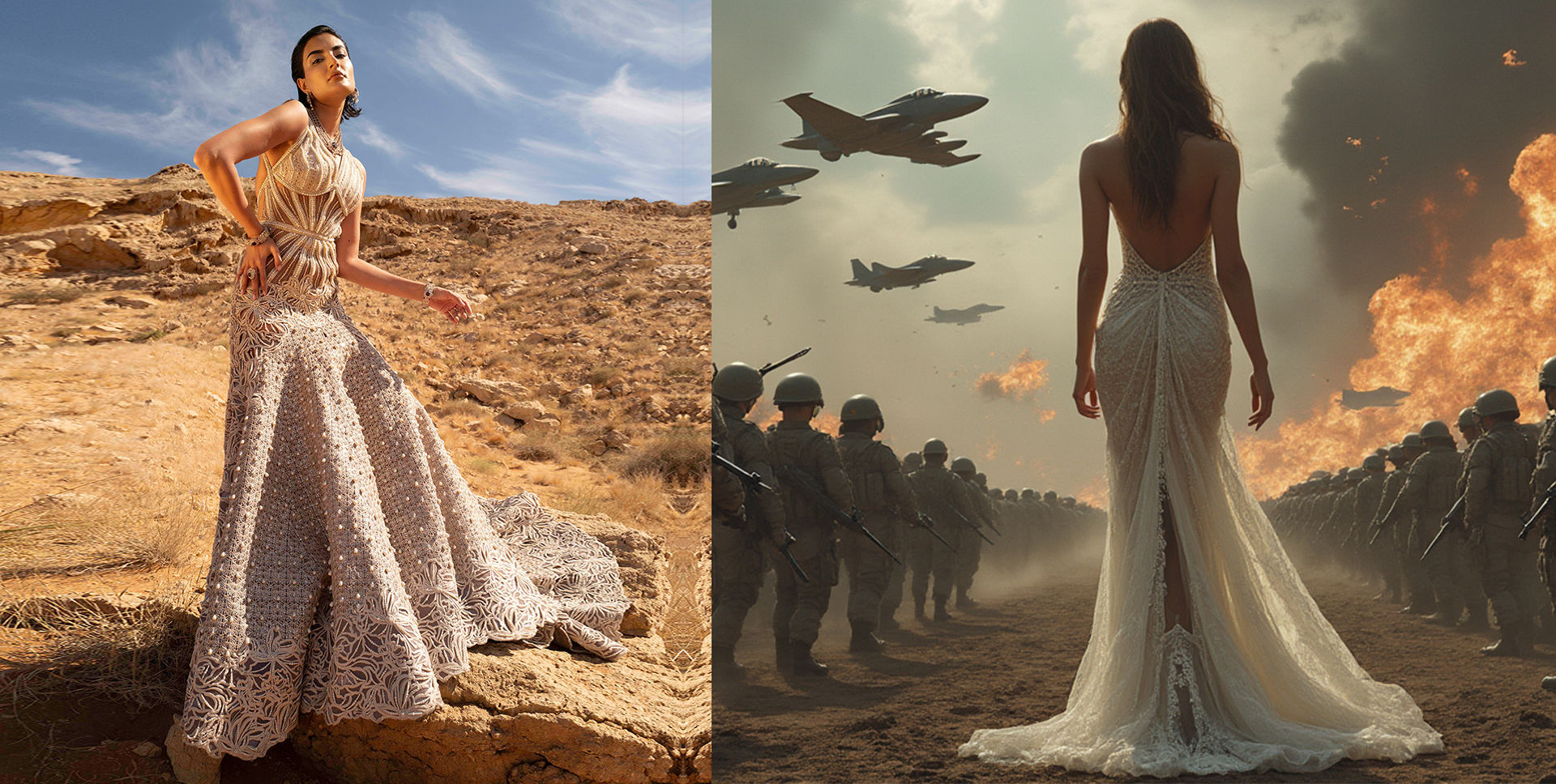
From disrupted supply chains to shifting consumer behaviour, this piece explores how the fashion industries of the Middle East and South Asia adapt, survive and evolve in times of conflict.
Fashion is a journey that hardly ever stops, even in times of war. The question is: how? The obvious responses are to push back timelines, navigate complex supply chain routes, manage clients who are themselves pressed for time, and contend with disrupted logistics - as well as the challenges faced by their teams.
Come to think of it, fashion has survived wars and pandemics, and in the case of the Middle East, persistent disruptions from all corners.
Supply chains collapse during war as infrastructure is destroyed. Energy remains a major factor in the current conflict. With the Strait of Hormuz compromised, oil reserves are at an all-time low, with uncertainty surrounding when there will be any relief.
In such grave circumstances, shipping is forced to reroute, causing significant delays. Insurance premiums are no longer guaranteed, which in turn drives up transportation costs. A setback of this scale contributes to global inflation and inevitably leads to the diversification of suppliers.
The International Monetary Fund issued a report on 30th March, citing energy prices, supply chains and financial markets as the main transmission channels, though regional factors are expected to vary. This is considered one of the largest disruptions to the global oil market in history.
The regional impact is already evident. Energy-importing economies across Africa, the Middle East and Latin America are bearing the brunt of soaring import bills, alongside increasing fiscal constraints.
In Asia, people’s purchasing power has come under pressure due to rising fuel and electricity costs. With currencies already faltering, it is becoming increasingly difficult to cope.
“The most vulnerable will bear the heaviest burden. People in low‑income countries are most at risk when prices rise because food accounts for about 36 percent of consumption on average, compared with 20 percent in emerging market economies and 9 percent in advanced economies. That makes any spike in fertilizer and food prices not just an economic problem but a socio-political one, especially where fiscal resources to cushion the blow are limited.” - IMF
If the energy and food crises persist, it is safe to say that inflation will reach an all-time high. Cultural resilience will be brought into question. Economies reliant on weaker currencies and high levels of imports are likely to falter. In low-income countries - including the Middle East, Central America and parts of Africa - where a large proportion of spending goes towards food, the economic costs will be significant.
As far as resilience in fashion goes, Lebanon has come to treat resilience more as a daily routine than a mere chant. Designers have come together to uphold what was already broken. The Lebanese have, to some extent, become desensitised given everything that has been thrown at them. They have defiantly become stronger as a growing community. “Creating art through war has made us resilient,” Chakra, the famous couturier, shares. “Whether people will rebuild is no longer a question - they just do.”
South Asians who manufacture in-house face dependency issues relating to international fabric sourcing. All of this has led to a level of preparedness that was never anticipated.
Clothing manufacturers and industry analysts are warning consumers to budget for price increases of 10 to 15 percent as the world prepares for what is to come. Air freight rates have driven costs up by 70 per cent for fast fashion products. Inflation and war crises result in fewer and weaker opportunities.
Cotton prices surging in Pakistan are an eye-opener. At the moment, they are at a relatively high level, but what lies ahead remains uncertain. Although prices in these markets tend to fluctuate, a cotton surge is never favourable for either balance sheets or consumers’ pockets. Stability seems far-fetched at this point. Prices are expected to rise further due to increasing production costs, and brands will likely have to increase retail prices as well, ultimately leading to a reduction in product quality if conditions worsen. The next time a new dress off the rack feels unreasonably priced or the fabric does not feel right, it may not just be inflation at play, but the use of synthetic rather than cotton fibres. The Gulf War is set to reshape Pakistan’s textile economy.
According to Fortune Business Insights (2026), the global apparel market share for casual fashion wear stands at 35.85 percent. Regional insights show that in 2025, Asia Pacific generated USD 740.26 billion, contributing 41.03 per cent to global market revenue, and is projected to grow to USD 769.67 billion by 2026. The UK market is projected to reach USD 94.77 billion by 2026, while the German market is projected to reach USD 83.51 billion.
The trifecta appears damaging: stock that sits unsold, delayed payments, and, of course, increased transportation costs.
Smaller suppliers and brands excel in speed, cultural responsiveness and digital adaptability. Larger brands have bigger marketing budgets, making them more exposed to scrutiny and potential boycotts. Smaller suppliers have fewer options, whereas larger suppliers are attempting to navigate these challenges unscathed, for now. Only time will tell.
Local brands have seen little to no change in consumers’ purchasing power. The heavyweight champion Khaadi continues to attract large crowds. “Business has not been affected at all,” asserts the brand’s CEO, Shamoon Sultan. Retailers such as Image have expressed a similar view.
In the luxury segment, designers such as Rizwan Beyg and Sania Maskatiya noted that sales saw a timely uplift due to Eid festivities.
Internationally, retail has not yet been significantly affected by shipping disruptions. According to Reuters, shipments of garments for Zara owner Inditex, along with other clothing retailers, were stranded due to the war.
Adaptability is everything. Brands have learnt over the past few years that, whether it is a war or a pandemic, the only option is to adapt. Uncertainty will affect GDP regardless. Value retailers such as Walmart, Kroger and dollar stores are likely to fare better, as they operate on a more value-driven pricing model.
So, is fashion frivolous in times of global unrest? Hardly. Resilience will eventually take over, as it always does. Nations are equipped to handle such risks. As Al Ali puts it, “Creativity does not stop during difficult times - it becomes more meaningful. Surrounding ourselves with beauty and hope is not superficial; it is human.”
Sign up now to get your brand listed on the largest eastern designer wear platform.



Take a screenshot, call/WhatsApp us at
+(971) 56 224 4288
or email at
[email protected]